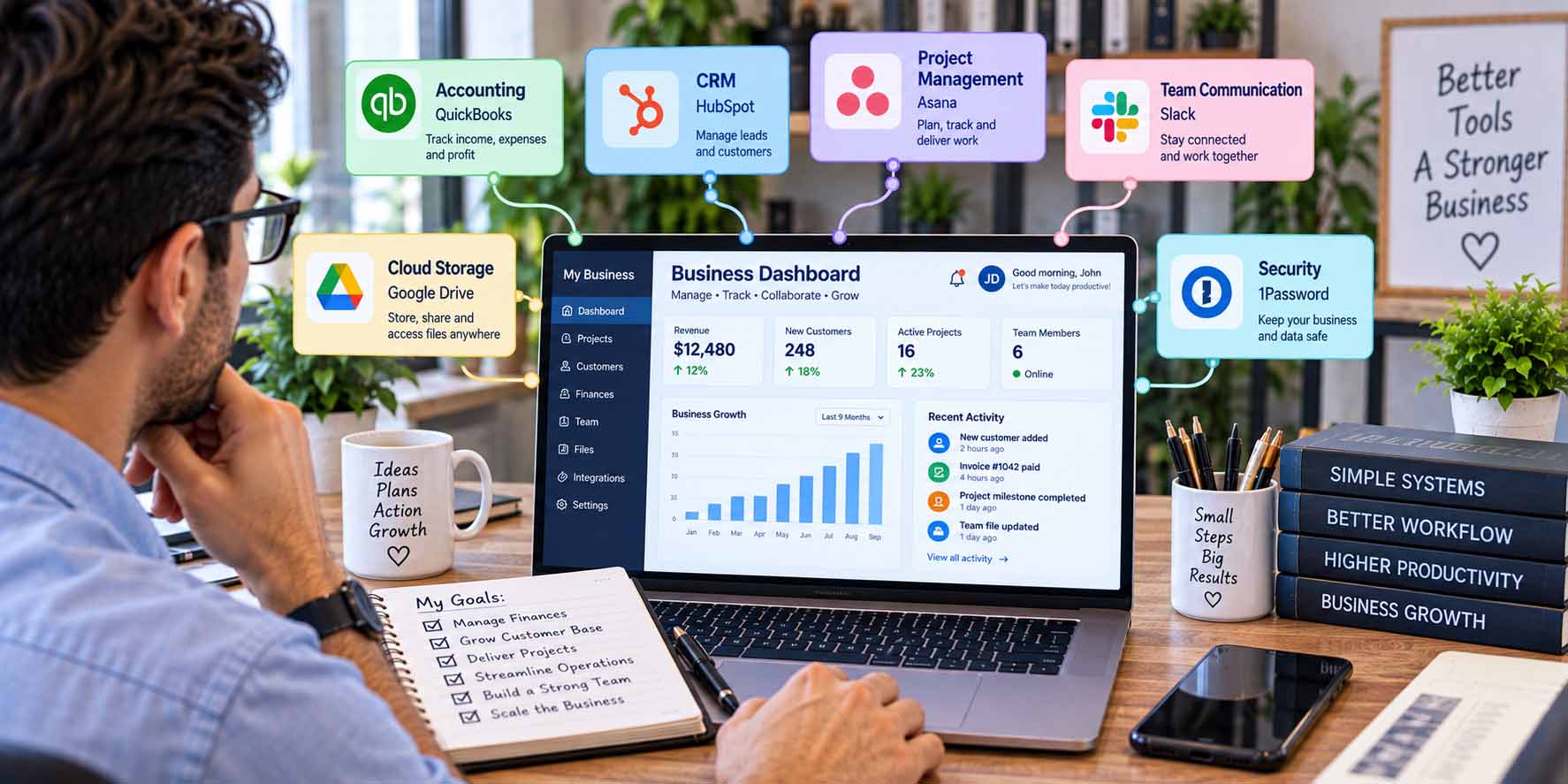
A small-business technology stack is the collection of digital tools a company uses to manage its everyday work. A simple stack should cover essential functions such as finances, customer relationships, projects, communication, document storage, and security without creating unnecessary software overlap.
For most small businesses, simplicity is valuable. The objective is to choose a manageable group of tools that work well together and solve specific operational problems.
What Should a Small-Business Technology Stack Include?
There is no universal list of software that every company needs. A retailer, consultant, agency, contractor, and online business may all require different systems.
However, several functions commonly form the foundation of a practical technology stack:
- Accounting and financial management
- Customer relationship management
- Project and task organization
- Team communication
- Cloud file storage
- Scheduling and calendars
- Security and access management
A business should add a category only when it supports an actual workflow.
Begin With the Work Your Business Already Does
Software selection should begin with processes rather than products.
Map the important activities employees perform during a normal week. Identify how invoices are created, customer information is recorded, tasks are assigned, documents are shared, and team members communicate.
Then look for problems.
Perhaps customer details are scattered across different spreadsheets. Maybe employees cannot tell who owns particular tasks. Financial records could require too much manual organization, or important files may be stored in several unrelated locations.
These problems help define what the technology stack actually needs to solve.
Choose a Financial Management Tool
Most businesses need an organized way to handle financial information.
Depending on the company, accounting software may support invoicing, expense categorization, transaction records, financial reporting, and other bookkeeping activities.
The right level of complexity depends on the business.
A solo operator may need straightforward financial tools, while a company with employees, inventory, multiple payment channels, or more complicated reporting requirements may require additional capabilities.
The important point is to select software that matches the current financial workflow while leaving reasonable room for growth.
Organize Customer Information
As customer activity increases, contact details and communication history can become difficult to manage through inboxes and spreadsheets alone.
Customer relationship management software can provide a central place for prospects, customers, conversations, follow-ups, sales opportunities, and related records.
Not every small business needs a dedicated CRM immediately.
If customer relationships are still simple, an existing system may be sufficient. A CRM becomes more valuable when employees begin missing follow-ups, duplicating communication, or struggling to understand the history of a customer relationship.
Add Project Management When Work Becomes Hard to Track
Project and task software helps organize work rather than customer relationships.
It can provide visibility into responsibilities, deadlines, milestones, dependencies, and progress.
A small team may benefit when employees regularly ask questions such as:
Who is responsible for this?
When is the deadline?
Has the previous step been completed?
Which projects are currently delayed?
Businesses researching software, operations, finance, and practical management topics can use this website from GrowBizLab as an additional small-business resource.
Project-management software is most useful when it replaces confusion with a clearer workflow. If the team already manages a simple workload effectively, adding a complicated platform may provide little benefit.
Keep Communication Tools Focused
A technology stack can quickly become confusing when employees communicate through too many channels.
For example, project decisions may be spread across email, direct messages, team chat, comments inside project software, and personal messaging applications.
Choose clear communication channels and define their purposes.
External customer communication may remain primarily in email or a CRM, while internal discussions may use a team collaboration platform. Project-specific updates might belong directly inside the project-management system.
The exact structure matters less than consistency.
Create One Clear Home for Business Files
Cloud storage can help employees access and share business documents from an organized location.
A useful storage system should have a logical folder structure, sensible permissions, and consistent naming practices.
Documents might include contracts, invoices, project files, marketing materials, operating procedures, reports, and administrative records.
Avoid creating unnecessary copies across several platforms. When employees cannot identify the current version of a document, the technology stack is creating friction rather than removing it.
Make Security Part of the Stack
Security is not simply another application to add later.
It should influence how every business system is selected and managed.
Consider authentication options, user permissions, backups, software updates, account recovery, and access removal when employees or contractors leave.
Employees should generally have access to the information required for their work rather than automatically receiving unrestricted access to every system.
A smaller, well-organized technology stack can also make account and permission management easier.
Look for Useful Integrations
Business applications often become more effective when they exchange relevant information.
For example, accounting software may receive payment information from another system, while project software may connect with calendars or file storage.
Integrations can reduce repetitive data entry and help information move through a workflow.
However, more integrations are not automatically better.
Every connection introduces another relationship that may require setup, permissions, maintenance, or troubleshooting. Add integrations when they solve a recognizable business problem.
Avoid Building the Stack Around Duplicate Features
Software overlap is one of the easiest ways for a simple technology stack to become unnecessarily complicated.
Many modern applications include secondary features such as scheduling, forms, task management, document sharing, messaging, reporting, and automation.
Before adding another subscription, check whether an existing tool already provides the required function.
Specialized software may still be worthwhile when it performs an important job better. The decision should be based on practical value rather than simply having access to another application.
Review the Stack as the Business Changes
A technology stack should evolve with business requirements.
Software that works for a two-person company may become restrictive as employees, customers, transactions, and projects increase. At the same time, tools purchased during an earlier stage may eventually become unnecessary.
Periodic reviews can identify applications that are no longer used, overlapping subscriptions, excessive user accounts, missing integrations, or workflows that need stronger software support.
When a problem appears, first determine whether an existing tool can solve it before purchasing something new.
Building a simple small-business technology stack is ultimately about creating a practical digital foundation for everyday work. By starting with real business processes, selecting tools for clearly defined purposes, limiting unnecessary overlap, connecting systems where useful, and reviewing the stack as needs change, a small business can use technology effectively without allowing its software environment to become unnecessarily complex.