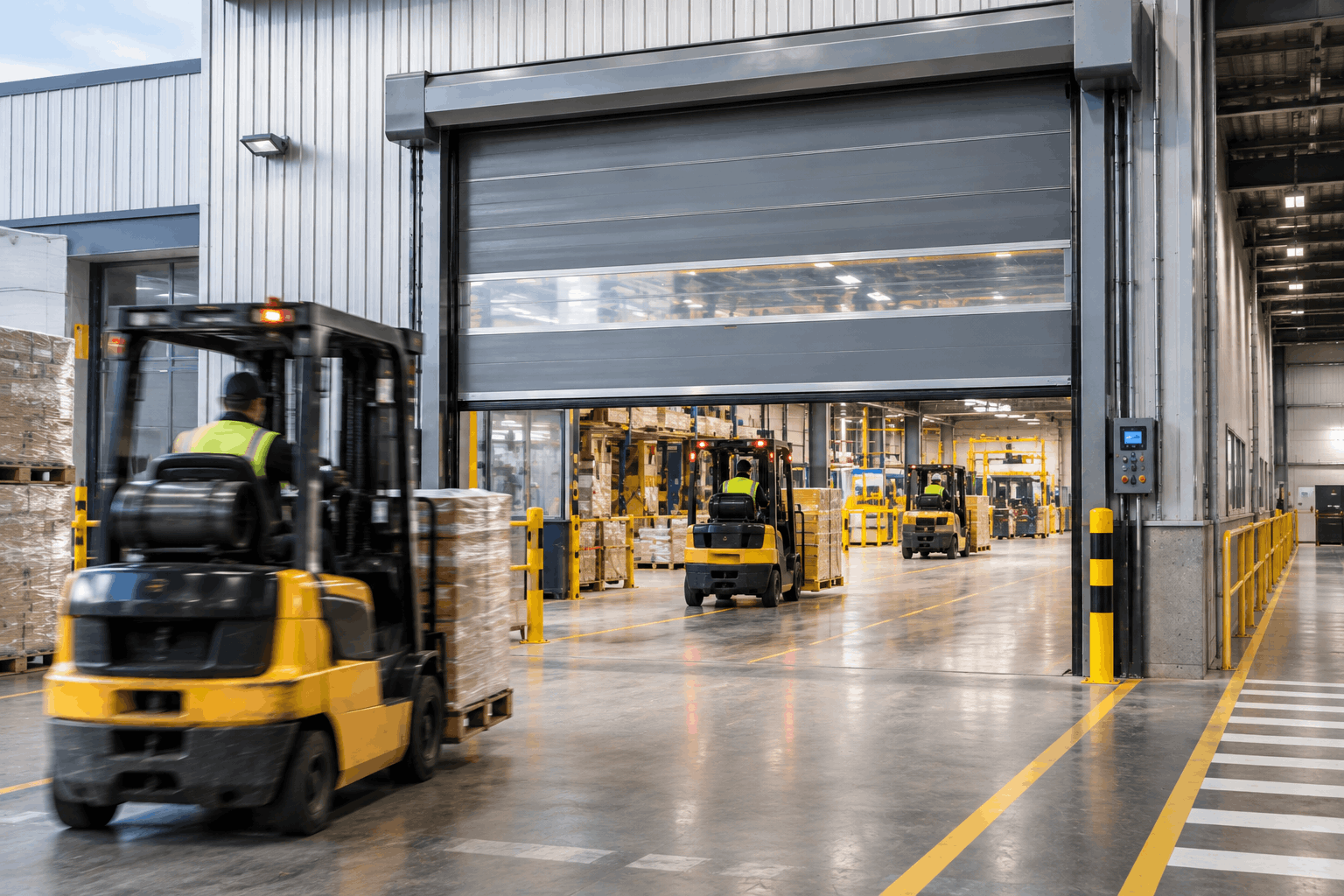
A high-cycle industrial door is designed for facilities where an entrance needs to open and close repeatedly as part of normal daily operations. These doors are particularly relevant to warehouses, manufacturing plants, logistics facilities, and other sites where forklifts, vehicles, workers, or automated equipment frequently move through the same opening.
The decision to use a high-cycle door should not be based on speed alone. Buyers should consider traffic frequency, opening dimensions, environmental conditions, construction, safety systems, automation, and maintenance requirements together.
What Makes an Industrial Door High-Cycle?
The term high-cycle describes the expected frequency of door operation. One cycle generally consists of an opening and closing sequence.
An entrance that operates only occasionally has different requirements from one that is triggered repeatedly during material handling and production activities. With frequent operation, the mechanical components, drive system, control equipment, guides, panels, and safety devices all need to be suitable for the workload.
This is why cycle requirements should be discussed during the specification process. The correct door is one that matches the actual operating conditions rather than simply having a high advertised opening speed.
Which Facilities Commonly Need High-Cycle Doors?
High-cycle doors can be useful wherever an industrial entrance experiences repeated traffic.
Typical applications include:
- Warehouses with continuous forklift movement
- Manufacturing plants with internal material transfer
- Distribution and logistics centers
- Automotive and vehicle production facilities
- Loading and unloading areas
- Production areas connected to storage zones
- Facilities using automated guided vehicles
- Busy vehicle-access entrances
- Industrial areas requiring frequent environmental separation
For example, consider a factory where forklifts regularly move raw materials from storage to a production line. If the same entrance is used throughout the shift, the door becomes part of the material-flow system. Its operating behavior can therefore affect how efficiently that route functions.
How Do You Know When a High-Cycle Door Is Needed?
The strongest indicator is repeated traffic through a single entrance.
Ask how the door will actually be used:
- How often will it open during a normal shift?
- Are there periods of especially heavy traffic?
- Will forklifts or trucks pass through?
- Will pedestrians share the entrance?
- Does the door separate production from storage?
- Is the entrance exposed to different temperatures or outdoor conditions?
- Does the facility use automated equipment?
- Would slow door operation create waiting or congestion?
If frequent operation is central to the workflow, a high-cycle industrial design deserves closer evaluation.
Traffic Frequency Is Only Part of the Decision
A busy entrance needs more than a door capable of repeated operation. The complete access system should fit the site’s traffic pattern.
For forklift-heavy environments, automatic activation can reduce unnecessary manual interaction. Radar, induction loops, photoelectric sensors, remote signals, or access-control systems may be used depending on the installation.
The opening and closing sequence should also be appropriate for the traffic. A door that remains open longer than necessary can affect environmental separation, while a door that closes without properly detecting nearby people or equipment can create safety concerns.
The objective is coordinated movement: detection, opening, passage, closing, and safety monitoring should work together.
Consider the Door’s Construction
Frequent operation places ongoing demands on an industrial door’s mechanical and electrical components.
Buyers should examine the complete construction rather than judging durability from a single specification. Important areas can include:
Rigid or insulated panels
Panel construction can influence durability, sealing, thermal performance, and resistance to the conditions around the opening. Where temperature control matters, insulated construction may be particularly relevant.
Drive and control system
The motor and control system need to support the intended operating pattern. Automated controls can also allow the door to respond to sensors, access systems, or facility equipment.
Guides and lifting arrangement
The way the door moves and is supported affects its use of available space and its suitability for the building layout. Spiral lifting configurations can be considered when a facility needs a high-speed rigid door while managing overhead space.
Safety equipment
Photoelectric sensors, light curtains, safety edges, emergency controls, and other protective devices can be selected according to the entrance’s traffic and risk profile.
High-Cycle Doors for Warehouse and Factory Traffic
Warehouses and factories often have several different traffic streams operating simultaneously.
Forklifts may transport pallets, workers may move between zones, and trucks may approach loading areas. When an entrance is used repeatedly, delays can accumulate into operational interruptions.
A suitable high-cycle door can become part of a broader traffic-management strategy. However, the door should be selected together with the surrounding layout. Clear vehicle routes, pedestrian separation, visibility, detection systems, and appropriate activation methods remain important.
For facilities comparing available configurations, high-cycle industrial doors can be evaluated according to opening size, traffic frequency, operating environment, automation requirements, and installation constraints.
What About Exterior Industrial Entrances?
Exterior entrances introduce additional considerations.
An outside door may encounter wind, rain, temperature changes, dust, and differences between indoor and outdoor conditions. In these situations, buyers should look beyond cycle frequency and examine sealing, panel construction, guides, environmental performance, and installation requirements.
The building’s location and entrance dimensions also matter. A door suitable for an internal factory connection may not have the same requirements as a large exterior warehouse entrance.
Automation Can Be Important in High-Traffic Areas
High-cycle operation and automation often go together because frequent traffic can make manual door activation inefficient.
Depending on the facility, a door may interact with:
- Radar or motion detection
- Induction loops
- Photoelectric sensors
- Access-control systems
- PLC-based controls
- Automated guided vehicles (AGVs)
- Robotic or material-handling systems
In a smart manufacturing environment, the industrial door may form part of a larger automated workflow. The important question is whether the control system can respond consistently to the way the facility actually operates.
Maintenance Should Be Planned From the Start
Frequent operation makes maintenance planning especially important.
Before selecting a door, buyers should understand routine inspection requirements, safety-device checks, service procedures, replacement components, and available technical support.
The maintenance schedule should also reflect the environment. Dust, moisture, vehicle impact risks, temperature differences, and heavy traffic can affect different components in different ways.
A useful approach is to establish maintenance responsibilities and inspection procedures before the door becomes operational.
A Simple Selection Checklist
Before choosing a high-cycle industrial door, facility managers can review these points:
- Traffic: How frequently will the entrance operate?
- Vehicles: Will forklifts, trucks, or automated vehicles use it?
- Dimensions: What are the required width and height?
- Space: What headroom and side clearance are available?
- Environment: Is the door internal, external, temperature-controlled, dusty, or exposed to weather?
- Construction: What panel and lifting configuration suits the application?
- Safety: Which detection and emergency systems are required?
- Automation: How should the door be activated and controlled?
- Maintenance: What inspections and service procedures will be necessary?
- Workflow: Will the door support the movement of materials and people without creating unnecessary bottlenecks?
The Practical Answer
A facility should consider a high-cycle industrial door when frequent entrance operation is a normal and important part of its workflow. Warehouses, manufacturing plants, logistics operations, and other high-traffic facilities can benefit from evaluating door systems specifically around repeated use.
The final selection should balance cycle requirements with construction, dimensions, environmental conditions, safety, automation, and maintenance. A well-specified industrial door is not simply a barrier that moves quickly; it is an access system designed to work reliably within the facility’s daily operating process.